Monday, November 14, 2016

Penang, Malaysia – November 5th – 9th, 2016

Once on the island of Penang, we made our way to the city of George Town. The city used to be an English colony in the 1800’s, but is now famous for its food! A cultural melting pot comprised of Chinese, Indian, and Indonesian influence, George Town was the perfect place to get our eat on! Over our four day stint, we walked the streets and sampled much of the local cuisine (without getting sick: WIN!). We tried tandoori chicken, an assortment of ramen, skewers that you cook in hot broth from a street vendor, dim sum, banana leaf rice, stir fry noodle dishes, Chinese biscuits, cake, oil drum toast, white coffee, etc. We also treated ourselves to chendol, a shaved ice dessert with green noodles and creamed coffee (which was delicious, says me, the person who doesn’t like coffee) and corn flavored popsicles (strange, but surprisingly decent). We also got to sample legit Chinese green and black tea while getting a one-on-one lesson on Chinese tea production from a passionate owner at a local shop. It was incredible! Andy tried Kopi Luwak, “the best and most expensive coffee in the world.” The beans are harvested from the shit of the Asian Palm Civet, a cat which eats coffee berries and passes the beans through its digestive tract. Andy absolutely loved it and agreed it was the best cup of coffee he had ever had. I did not try the cat poop coffee. You would think that this gorge fest would set us back financially, but no, we could afford to eat as much as we wanted (and more) since most local fair was less than $2 for a meal!
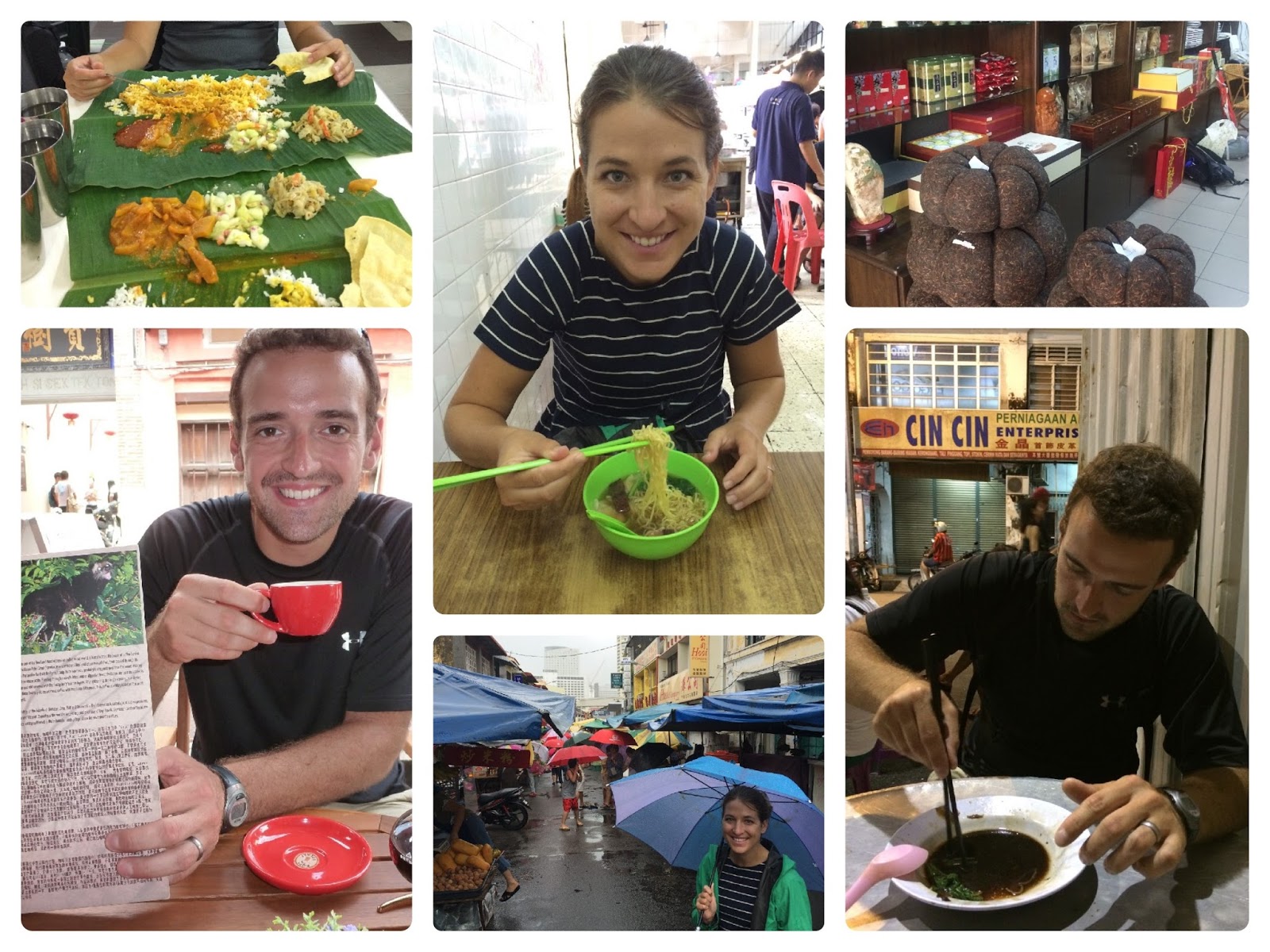
Eating our way across George Town.

Some of the sites around Penang.
Between meals (and snacks), we strolled the streets of George Town looking for murals and wire art. The city itself is clean with many historic white colonial buildings, but the search for street art made it even more fun to walk through. The building murals ranged from dinosaurs on leashes to anti-smoking campaigns and everything in-between, while the wire art gave tidbits of local history. In addition to viewing other people’s art, I also created my own abstract art at a coffee and cake shop which supplied table cloth paper and pastels.
Art work around George Town, including my masterpiece in the bottom left. 
The hostel that we stayed at (We Luv Travel Guesthouse) was absolutely amazing. Not only was it clean and comfortable, with super-fast wifi, but it was more like a home stay than a hotel. Throughout our stay, the staff insisted that we try all of the food they had ordered or cooked, made us their secret recipe french toast (which was incredible), taught us some George Town and Malaysian history, helped with travel arrangements, and more. The owner also brought us into his modern Chinese medicine clinic and had us try out all his gismos while teaching us along the way. There was the foot shocking gismo, a band which makes you electrically charged (which supposedly makes you negatively charged by filling your cell's valance electrons sites), and an infrared heating bed with a leg shaker. He even helped treat Andy’s persistent head cold by centering his chi.  

On our last day on Penang, we rented a scooter and toured the island. The 24-hour rental cost all of $8, so why not? I’ll tell you why not – being the backseat scooter driver in traffic on the opposite side of the road is terrifying! In good news, we did not crash and actually started to get used to it by the end of the day. We drove to a Chinese temple and yet another National Park about 45 minutes outside of George Town, where we hiked ~3 hours round-trip to Monkey Beach. True to its name, a team of criminal monkeys pulled off a distraction scam while the other hung upside-down from the side of a rope swing to steal my apple straight out of my hand! It was startling to say the least, but we have to give them props, it was a perfectly executed con.
Penang by scooter. One of the apple (and swing) thieves is shown in the bottom middle.
From George Town we left via minibus towards Thailand. Andy and I both agree that so far, Malaysia is one of our favorite countries and we were more than a little sad to be leaving. The people are more kind than we could have ever hoped for and it was refreshing for things to be easy for a while. The only major downside to Malaysia was the smoking. Even with a clear push to inform people of the hazards of second-hand smoke, smoking is a major part of the Malay culture. In Taman Negara National Park, many restaurants claimed to be non-smoking, while the locals chain smoked right under the no smoking sign. In George Town, the city has implemented a no smoking policy with gigantic fees associated with smoking in any public place. Unfortunately, laws are only effective if they are enforced and we never once saw a person utilizing one of the ~2 ft. diameter smoking circles scattered throughout the city. At least they are half trying… 

Sunday, November 13, 2016

Taman Negara National Park, Malaysia – November 2nd – 4th, 2016

We fancied a visit to Taman Negara National Park, so we booked bus/boat transfer through a travel agent from KL to Kuala Tahan, the village just outside of the park. After a 3-hour minibus ride, we putzed around for a few hours before finally departing on a long, skinny, wooden motorboat up the Tembeling river. The boat ride was surprisingly uneventful. The motor problems were likely the most exciting part of the 3-hour trip, although we did spot a couple of monkeys, birds, and domestic water buffalo. We finally arrived and made our way through the quiet village towards the place we had planned to stay. We received a fair room rate, $10/night, and settled in, just narrowly avoiding the monsoon storm. Towards the tail end of the storm, we walked the 10 minutes back to the river for dinner since our “chalet” restaurant was not open during the non-peak tourist season. I again hated what I ordered, surprise surprise. It turned out to be noodles and vegetables in a mostly flavorless, clumpy, corn starch paste soup. Sounds appetizing doesn’t it? Andy’s food was pretty good (am I the only one noticing a trend here?).      
On the way to Taman Negara National Park. The hut in the center is our "chalet".
The next day we ventured across the river and into the park. We are officially incapable of taking it easy, so we hiked all of the trails that we were allowed to do without having a guide. Yes, you read that correctly, all of them. It took us ~9 hours in the hot, humid rainforest and we were absolutely exhausted afterwards. The first trail was a summit up a seemingly endless number of steps to an overlook on Bukit Teresek. It was sweaty work, but the view was worth it. The trail was on a platform walkway keeping you above the ground and protected from the monsoon runoff and snakes. The second trail was actually a canopy walkway along suspended rope bridges. It was really cool! The last trail followed the river through an aborigine village and finally up a narrow roped ridge to the summit of Bukit Indah. To be fair, the last trail was more like bushwhacking than hiking. Overall, the park was nice, but since we were only allowed to be on the trails that hugged the park boundary without a guide, we saw almost no wildlife. We spotted a couple of monkeys and many bugs (notably termites), but that was it. Regardless, the rainforest is some of the oldest untouched forest in the world, so we were glad that we went, although perhaps not being cheap asses and hiring a guide would have been more of an experience.
Hiking in the National Park. 
Since we can’t seem to stay in one place for more than 48 hours, we left on a public bus the next morning (which was super nice by the way – go Malaysia!). We actually didn’t just ride on one bus that day; it took us four buses and an Uber to get to our hotel in George Town. We had actually set out that morning towards a beach town north of KL, but while en route, decided, what the heck, we hate relaxing, let’s just go all the way to George Town, 13 hours away. We booked the hotel from the bus. We should really learn to take it easy. 

Sunday, November 6, 2016

Kuala Lumpur, Malaysia – October 29th – November 2nd, 2016

Kuala Lumpur is a REAL developed city – cleaner than and just as updated as many major cities in the US! At first we could not believe that the plane didn’t accidentally drop us off at a nice city in Florida. The public transit is easy to navigate, they drive in lanes on paved roads, the electricity appears to be safely wired and works consistently, there are plumbing and waste management systems, they have washing machines and dryers, and besides the occasional strange smelling food, it smells clean (no dust and minimal smog)! The city also appears to be appropriately sized, meaning that the city planners have their shit together. If you couldn’t tell, we were very impressed with Kuala Lumpur (KL)… not to say we didn’t have our challenges in the first day or two.

We arrived at the airport and cleared customs, still feeling pretty crappy from the great Nepali food crises, round 2. Our first order of business was to get Malaysian ringgit (MYR) to pay for the bus towards our hostel. After 3 ATMs failed to give us money, Andy called the bank through the free KL airport high speed wifi (like I said… impressive) while I asked around at the multiple money exchangers/banks in the airport to exchange the Nepali money (NRP) we had left. I was unable to find a place to exchange the money (they refused to exchange NRP for some reason), but luckily Andy worked things out with the bank and we got some money from an ATM. After picking up some snacks at a real live grocery store at the airport, we went to buy our bus tickets. The price was 22 MYR so I handed the woman two one dollar bills and a coin that said 20 on it. Being that this was the first time we had been in a country that used coins for change less than 1 ringgit, I was startled to find out that I had actually attempted to pay her 2.20 ringgit. After making many mistakes like this over the last two months, we had a good laugh at my stupidity and were on our way (after giving her a 20 ringgit bill instead of 20 cents of course).

On our first day in KL, we ventured out to watch the MotoGP motorcycle race. Coincidentally, the race was taking place on the weekend we were arriving and since it is a huge international event, famous race track, and there is a massive Malaysian fan base, we got tickets while we were still in Nepal.  From our research in Nepal, we saw the main race started at 12:45 pm so we left fairly early to make sure we got there with plenty of time. Unfortunately, the bus ride turned out to be more of a parking lot visit and we found ourselves ~20 minutes late for the race. Worse than that, it was pouring rain and it took us over 30 minutes to figure out where our seats were, so by the time we sat down on the covered dirt lawn surrounded by smoking Malaysian fans, the race only had 9 laps to go. We were so frustrated and disappointed! We tried to make the most of it though, and watched the rest of the race from our surprisingly good vantage point. With the race over, we were confused to find that nobody got up to leave. After many, many confused minutes, we asked some nearby drunk Aussies what race we just watched. After looking at us like we were complete morons, they answered Moto2 (meaning the lower class of racing) and explained that the race was scheduled to start at 3pm and the only thing to start at 12:45 was the drinking! It took us several more hours before we realized that our mistake originated from the 2 hour 15 minute time difference between Kathmandu and Kuala Lumpur. Anyway, long story short, we saw the entire race and even lucked out on our dirt spot, staying dry while the surrounding people were sitting in a mudslide from the bouts of torrential downpours. The race was exciting and we watched two crashes right in front of us! Well worth the $10 each for tickets! The bus ride back was, believe it or not, longer that the bus ride to the race. It took over two and a half hours! All in all, we spent significantly more time on the bus than at the race track that day.
Sepang MotoGP
The next day we sought out to exchange the Nepalese money. We had planned to exchange the ~36,000 NPR ($330) in Nepal before we left, but the money exchangers in Kathmandu did not have MYR and we did not feel up for walking around to figure it out. We just assumed we could exchange it in Malaysia. WRONG! Apparently, Nepal has a closed currency, meaning that not only can you not exchange money outside of the country, it is actually illegal to take money across the border! Who knew that was even a thing!??! Not us! Many google searches revealed that our only option was to find someone traveling to Nepal and strike a deal with them. We asked around the hostel, left a hilariously witty note in the common room, emailed some contacts in Nepal, and went to a couple more private money exchangers with no luck. The problem was finally resolved through following a lead from the hotel owner in Kathmandu, who directed us to a money courier, who told us to go to a different private exchanger, who finally gave us a decent exchange rate. Phew, crises averted again!

The food in KL was YUM! There was everything from authentic western foods to delicious Malay food and everything in between. Our culinary highlights included a trip to McDonalds where we chowed down on cheeseburgers and McFlurries. In the US, I had not been to a McDonalds in over a decade, but it tasted SO GOOD! We also at Din Tai Fung, a Chinese Dim Sum restaurant that has several branches all over the world. Andy had eaten at one in Hong Kong several years ago while on a work trip, and has now eaten at the restaurant in Kuala Lumpur, but has not managed to make it to the branch that is less than a mile from our house in Seattle! We also ventured out of our comfort zone to eat some traditional Malay black hokkien mee noodles. Unsure of the type of meat they put in the noodles, we asked for it vegetarian, and a local in line ahead of us was nice enough to translate our order for us. We thought we were in the clear, but really they just added the chunks of animal fat in mine, rather than animal fat and mystery meat/seafood. Lucky me. Andy’s fat-free noodles were delicious though!
KL's culinary wonders.
While we weren’t fighting crowds at the MotoGP and attempting to fill our bellies again after the previous 4-day fast, we walked around the city, visited a rainforest park with some of the oldest fully-preserved rainforest in the world, watched a light show at the Petronas towers (skyscrapers), and shopped. With more malls than you can count, KL is known for fashion and shopping. Since it appeared that we severely under packed, we made full use of the brand name western stores and stocked up on a couple more shirts, a pair of convertible hiking pants and shorts for Andy, and some underwear and socks. The past several months had taught us that having only four pairs of underwear and socks meant that you had to do laundry (in the sink) at least every 3 days. This assumes that the laundry will actually dry in one day, which it won’t because the air is as moist (that one’s for you Lillian) as the clothes. While shopping at one of the markets we were also shocked to find that a 512 GB flash drive was being sold on sale for 10 MYR (~$2.50)! We hadn’t even realized that technology had advanced so far as to compact that much storage into a tiny flash drive, and at such a low price! The truth, we realized later when plugging in our exciting purchase, was that if it sounds too good to be true it probably is. The flash drive was a scam and completely fake. Turns out technology has advanced that far, but you’ll pay about $300 for a real one (not $2.50). Oops. 
The sites around KL.

Saturday, November 5, 2016

Kathmandu, Nepal – October 26th – 29th, 2016

Nepal ended in much the same way as it started: hugging the porcelain thrown (or porcelain platform in the case of a squat toilet). Except, extra fun, this time we were sick at the same time and it lasted 4+ days. The culprit was likely the unrefrigerated mayonnaise that tasted curiously like coconut, which unwantedly made it onto some sandwiches that we ate on the journey from Chitwan to Kathmandu. Our entire stay in Kathmandu ended up being spent making the trip between the bed and the toilet. Nausea, diarrhea, headache, neck pain, aches, chills, fever (unconfirmed since, against my suggestion, Andy left the thermometer acting as a window prop in the ashram in India), weakness, residual sinus pressure/runny noise from the previous week’s cold, you name it, we had it. At first it seemed that Andy was taking the brunt of the illness, but I quickly caught up to join him in the fun.

We also found that our tolerance towards Kathmandu had decreased significantly. It is amazing how fast you become de-desensitized. After Dehli, Kathmandu looked like child’s play, but after three weeks in the Himalayas, Kathmandu looked a lot more like a massive, crowded, dirty, dusty city. Perception is a crazy thing. 

On the evening before our flight to Kuala Lumpur, Malaysia, we felt compelled to venture out of our sick beds to see some of the sites (which is, believe it or not, why we traveled to Nepal). This was a massive mistake, since the 37 km (23 mi) journey up to the Nagarkot sunset overlook ended up taking over 4.5 hours roundtrip in stop and go traffic on bumpy windy roads. Additionally, the view was hindered significantly by clouds and we were both on the verge of losing what little food we had managed to consume. We literally ran back into the hotel bathroom from the taxi! The next day, we had a full day of travel ahead of us that we could not reschedule since our flights were non-refundable and our visas were about to expire. We broke down and took some antibiotics, hoping that they might make the next day more possible/bearable. The problem with antibiotics is that they are only effective if you do not promptly throw them back up all over yourself…
The views around Nagarkot.
 The morning of our departure was not much better than the night before and we had serious doubt as to whether we were capable of making the trip at all. Luckily, the travel went surprisingly smoothly and we were feeling slightly better in the afternoon. The plane was huge and less than 20% full leaving us plenty of room to spread out and relax. We even ate the food on the plane which was quite the accomplishment! Nepal was absolutely amazing and we met so many incredible people, but I can’t say we were sad to leave the poor road conditions and food safety problems behind.  

The sites around Kathmandu and Andy's beard removal process.

Thursday, October 27, 2016

Chitwan National Park, Nepal – October 23rd – 26th, 2016

Rather than endure two overnight 20+ hour bus rides to Bardia National Park (where we actually wanted to go), we settled on the more touristy, but conveniently located Chitwan National Park. Since everything in the park has to be guided, we felt forced into taking the advice we received in Pokhara and going with an all-inclusive hotel with a tourist itinerary. Added bonus was that we did not have to plan anything for 4 days and the price was definitely right. Serious downside was that it turned out that we had to attempt to curb our type A personalities substantially because the hotel was so unorganized! We spent most of the time wondering what we were supposed to be doing or asking questions to each other attempting to reason out the way things operated at the hotel. However, like most things type A personalities try to control, everything worked out fine and we had a fun couple of days.

On our first full day we did a canoe ride and an 8 hour trek through the jungle. Within the first 10 minutes we saw a rhinoceros! It was so much bigger than either of us remembered from our previous experience with rhinos (at the zoo). We found out later that wild rhinos are actually very dangerous and the technique we should employ if/when a rhino chases us is to run erratically in a zig-zag pattern, every man for themselves (another example of some not very confidence inspiring advice from a guide). Lucky for us we never had to find out who is the slowest runner and our two guides flanked us through the entire trek. Along the jungle trek we saw many deer, two different types of monkeys, domestic elephants, many birds, crazy red bugs that shed their skin like snakes, peacocks (which can fly! who knew?!), man eating and non-man eating crocodiles, and my personal favorite, three toucans! We also saw footprints and other evidence (including poo) of sloth bears and tigers. The guides were impressively knowledgeable, spouting off bird names just based on the sound of their wings.
Along the jungle trek. 
Some of the animals we saw at Chitwan. The top-left photo is not a rock, but a man eating crocodile!
The next day was all about elephants! In the morning, we went on an elephant safari (in other words, an elephant ride through the jungle). Apart from it being super cool that we were riding an elephant, the fauna was not afraid of the elephant so we saw deer and moneys up close and personal. The only downside was that the mahout (elephant trainer) could be a bit aggressive with our timid elephant. When the elephant was not going fast enough or afraid of mud or a small hill, the mahout would hit it on the head/ear with a curved piece of rebar! After the elephant safari we took a bath with an elephant. You ride on the neck of the elephant while it sprays you with water from its trunk and eventually lays down, throwing you into the water. SO MUCH FUN! Again though, the experience was hindered by the rebar stick used to poke the elephant… Lastly, we did a bike ride to the elephant breeding center, where we learned some of the history and practices of breeding and training elephants. Oh and we also hung out with the elephant babies and saw a wild boar too! We made friends with a 4-month-old elephant that was clearly already a handful because he continued to knock over the fence post to join us on the opposite side of the fence. The training process occurs when the elephants are 2-3 years old and basically consists of breaking the elephants spirit. Downer moment… not sure that we feel good about ourselves for supporting the elephant culture.
Elephant activities. 
The morning of the 26th, we took another very grueling bus ride back to Kathmandu. The 6-hour bus ride became over 8.5 thanks to the quality Nepali roads and Andy was not feeling well for most of the journey. He had been battling a cold since Pokhara and appeared now to be losing the fight. With only two full days in Kathmandu before leaving for Malaysia, we hoped he would feel better quickly. Spoiler alert: hoping didn’t work.  

Pokhara, Nepal – October 18th – 23rd, 2016

After yet another grueling bus ride, we shared a jeep with some other trekkers for the last leg to Pokhara, a touristy lake town and perfect place for a little R&R. Our time in Pokhara was mostly spent eating, sleeping, and hanging out with the friends we had made on the trek. It was glorious. Though, after four days of this, we were starting to feel pretty antsy and ready to start using some muscles (other than our mouths) to see more of the beautiful country we were lucky enough to be visiting.

I suppose we did actually do some notable things in Pokhara, first of which was splurge on massages! Set up through our amazing hotel (The Mountain House, if you ever go to Pokhara, stay here, the owners are unbelievably kind and helpful, and the rooms are enormous and clean). The massages were at a legitimate spa, Serenity Spa – unlike our massages in Peru a few years ago which were in a not-so-legitimate storage room. For ninety relaxing minutes, the masseuses rubbed away some of the aches and soreness from our exhausted bodies. Dani also got an interesting and hilarious “chest” massage surprise! Though on the pricey side, we were glad we gave ourselves the spa gift.
Our many pictures of Fewa Lake
We also did this fun little activity called PARAGLIDING!! It was such a blast, riding thermals and soaring higher and higher above Pokhara, the lake and surrounding hills. My pilot even allowed me to fly us around for a bit and do some aerobatics! It looks easy, but you have to pull pretty hard on those strings to deform the parachute enough to make a turn. I am also having a hard time suppressing my smugness about my flight lasting longer than Dani’s.
Our Pokhara paragliding extravaganza!

On one of our last days, we took a crappy two-seater kayak out onto the lake, which was very frustrating as it was missing a stabilizer fin and rudder and we kept going in circles and circles for no apparent reason. Much finger pointing ensued, but we could laugh about it in the end. The next morning, we caught a surprisingly nice tourist bus (again arranged by our spectacular hotel owner) to Chitwan National Park. 

Friday, October 21, 2016

Annapurna Circuit, Nepal – September 30th – October 17th, 2016

Our first impressions of Kathmandu were in contrast to what we had heard from others about the massive capital of Nepal. After coming from Delhi, Kathmandu was not at all busy, noisy, and dirty, it was actually, SO CLEAN!!! We excitedly pointed out trash cans and managed to make it the entire way to our hotel (~45 min.) without seeing almost any waste (human or otherwise) on the streets! We instantly felt more comfortable. We spent our first day and a half in the Thamel district aka the “tourist ghetto” gathering the necessary permits, bus tickets, and gear for our upcoming trek around the Annapurna Circuit. This did not exactly go smoothly since it took us over 3 hours to find the bus station and buy tickets (even with the help of a local). Regardless, on the 2nd of October we were bright eyed, bushy tailed, and ready to start the trek.

We took a local bus from Kathmandu to Bessisahar, the starting point of the trek – BIG MISTAKE! Although we saved a whopping $12 compared to the tourist bus, it took us about 9 hours in hell to get to our destination (side note: it was supposed to take 6 hours). We got stuck in a massive traffic jam leaving Kathmandu, stopped for anyone who needed a ride along the way, it was hot and humid with no A/C, we inhaled dust, dirt, and engine fumes the whole trip, the bus seats were appropriately sized for children under 5 feet tall, I was car sick for about 6 hours of the windy, bumpy journey through the mountains, we both had splitting headaches, and to top it all off I had a Nepali’s armpit about an inch from my face for the last 3 hours.
Bus Pain.
In Bessisahar, most trekkers take a second bus on the dirt road to one of the first villages to stay the night, but you could not have paid us to get on another bus, so we started walking. After a 2-hour trek through beautiful terraced rice patties, we arrived at our first guest house. The accommodations were… what you needed and nothing more: a metal shed with thin foam mattresses on plywood and a squat toilet/cold shower next door. I was able to overlook all of this, still excited for the trek, until the following day when I got food poisoning. I have never been more violently sick in my life and to add to the fun the bathroom was a communal squat toilet that you dump water down to "flush". Let’s just say, marriage really does mean for better or for worse. While attempting to recover the next day, I discovered that my blood had been stolen by a leech. The day after that I was stung by a… something and the following day we walked in the rain for most of the day. Admittedly, Nepal was not getting off to a great start. I may or may not have shed a couple of tears.
Days 1 and 2 on the trek: hot and humid with lush greenery!
Days 4, 5 and 6: Beautiful villages and trails cut into rock faces.
Luckily around day 6, things started to improve significantly. I got stronger and started eating almost normally again, despite the food aversion to rice, vegetables, eggs, and Nepalese spices (which by the way made up pretty much all of the food options). The guest houses also turned out to be much nicer than the one we had stayed at the first night. For 14 days, we strapped on our backpacks and followed the guide book through the Himalayas and over the “biggest pass in the world” at almost 18,000 ft! Being the closet nerds (“closet” may be up for debate) that we are, we put together some graphs for you with some of our trek stats. Figure 1 shows the elevation on the y-axis and distance on the x-axis with our overnight stops along the way shown as red dots. The dashed line indicates where we took a bus because we were too tired to keep backpacking.
Figure 1: Elevation vs. trekked distance.
Figure 2 shows a breakdown of the 63 people from 18 different countries that we met and hung out with on the trail. Besides the ridiculously beautiful scenery, one of the coolest parts of the Annapurna circuit was getting to converse with amazing people from all over the world. We met many people that were traveling full-time in the exact same situation as us – frustrated with the work life balance and wanting a change. They gave us some great ideas, inspiration, and motivation to keep with it, even when things aren’t exactly going your way (refer to 2nd and 3rd paragraph of the post).

Figure 2: Frequency of nationalities encountered on the trek.
Over the 2-week trek, we were shocked at how much the scenery in the Himalayas changed. We started in the tropics surrounded by rice patties, jungle, and bugs and summited in the desolate high alpine. In between, there were pine forests, colorful deciduous trees, deep canyons, and arid desert. We were even convinced at one point that it could have been Colorado, minus the towering 26,000+ foot peaks. The weather also varied from hot (in the 90’s) and humid at the lower elevations to freezing your ass off and dry above 15,000 feet. Thanks to the knock off sleeping bag and down jackets that we rented, we were freezing cold for about half of the trek. Some of the trip highlights were the towns of Tal and Upper Pisang, a side trek to Tilicho Lake (proclaimed as the “Highest Lake in the World” at 16,400 ft), going through Thorung La Pass at 17,765 ft, and the countless suspension bridges along the trail!
Days 6, 7 and 8: less hot and humid, and beginning to look a lot like CO!
Days 9, 10 and 11: Tilicho Lake and high alpine views.
Days 11 and 12: Continuing towards the pass!
Day 13: Thorung La Pass, 17,765 feet! In the bottom left photo, Andy is pointing to the pass from the other side.
Day 13 and 14: Heading down and down and down from the pass.
Day 14: Continuing our decent through the town of Kagbeni with its unique sculptures.
Day 15: Our last day of trekking. The wind was throwing dust in our faces all day and our legs were so tired that we decided to take a bus down the following morning.
Day 16: Views from Tatopani, the last place that we stayed on the Annapurna circuit. We soaked in the hot springs and gorged ourselves at the guest house restaurant. 
In addition to the amazing surroundings, we got to experience the culture of Nepal. We saw stupas, gompas (aka monstaries – this by the way took us over a week to figure out), prayers wheels, Tibetan prayer flags, Hindi temples, traditional mountain villages, and talked/played cards with many locals. The Nepali people are ridiculously nice and always agreeable. Even if they don’t understand you, they’ll agree just to please you. This however, resulted in some frustrating, yet hilarious situations. For example, I asked a woman at the guesthouse restaurant what the “Mixed Potato” was on the menu. She said it had vegetables. I then asked, “Ok, what is the difference was between Veg Potato and Mixed Potato?” She answered with a warm Nepali smile, said, “Okay”, gave me the Indian head nod (hereby renamed the Indian/Nepali head nod), and walked briskly away. My Mixed Potato dinner arrived a half hour later. It included, potatoes, vegetables, eggs, and canned tuna all mixed together… Andy the saint swapped meals with me.
Some of our accommodations along the trek
The Annapurna Circuit was amazing and we would recommend it to anybody, but there are some definite negatives about Nepal. First and foremost, everybody smokes here! You can’t get away from it and even if you could you would instead be confronted by trash and/or dried cow/yak poop fires, which is admittedly very resourceful, but smells as you would expect: like burning shit. Also, the road conditions leave much to be desired. Even if the road is pseudo paved, a bus ride in Nepal is like getting on the Indiana Jones ride at Disney Land: Its super fun for the first 10 minutes, but the fun ends when you realize you can’t get off. The bus rattles you around like a rag doll for hours on end and we are convinced that many of the drivers are actually rally car racers in disguise. Lastly, the Nepalese people are super human when it comes to high altitude and body temperature regulation. This may seem like a positive, but, really, it translates to uncomfortable living conditions for all of us mere humans. They do not seem to be affected by the cold at all. They may light a measly fire to heat the dining space (or “dinning” space, as they like to spell it), but leave the outside door wide open just to mess with you. At one lodge, I must have gotten up and closed the door 30 times!!!

In 14 days, we hiked about 113 miles and gained 25,750 feet of elevation! This does not include the everyday up and down (Nepali flats). We are not usually ones to brag, but before we go on, let’s all take a moment to let us toot our own horn: TOOT TOOT!!! Perhaps walking really is a valid mode of transportation (said like a true American) :)